Most Developers Treat Feasibility as a Spreadsheet. On Uttoxeter Road, It Was a Design Decision
By Studio Tashkeel Architecture - a planning-led architectural design practice founded in 2017, with 400+ completed projects across the North West.
Ask most developers what a feasibility study is, and you'll get some version of the same answer: a check on whether the numbers work. Costs in one column, values in another, and a margin at the bottom. If the margin survives, the site is "feasible".
That definition is why so many sites disappoint after an exchange – and the reason has nothing to do with the numbers themselves.
The spreadsheet was never the problem
The spreadsheet doesn't tell you what you can build. It assumes an answer to that question and then does arithmetic on top of it. And the assumption - how many homes, what massing, what the planners will accept - is an architectural judgement, not a financial one. Get it wrong by a single storey or a handful of units, and every figure beneath it is wrong too.
Which raises the obvious question: if the most important number in the whole appraisal is actually a design decision, why is it usually the one nobody designs?
This is the story of a site on Uttoxeter Road in Stoke-on-Trent, where a North West developer asked the question in a different order - what can this land actually deliver? - before asking what it would be worth. What he got back changed the shape of the deal entirely.
The category error that costs developers the most
At times, the site looks promising. And the plot is the right size, the location stacks up, and the pressure to move is real because good sites do not sit around. So you get tempted to run the numbers, trust the margin, and proceed.
But "promising" and "viable" are different things – and only one of them can be confirmed with a calculator. A plot's real capacity is governed by planning policy, context, access, daylight, massing and a dozen design constraints that don't appear on a spreadsheet, because they have to be drawn before they can be known.
Skip the drawing, and you haven't bought a development. You've bought a hypothesis with a confident-looking number attached.
The developer on Uttoxeter Road chose not to buy a hypothesis. Here's what he did instead.
The brief: a piece of land, and an open question
Our client came to us with the site before committing to it and asked the only question worth asking first: What can I build here, and is it worth pursuing?'
Rather than start from a desired answer and work backwards, we started from the site itself. We tested it against Stoke-on-Trent's local planning policy, read its context and constraints, and asked what good design could responsibly draw out of it. This is Stage 2 of our Pre-Acquisition Framework - see the 3/6 questions breakdown on our LinkedIn.
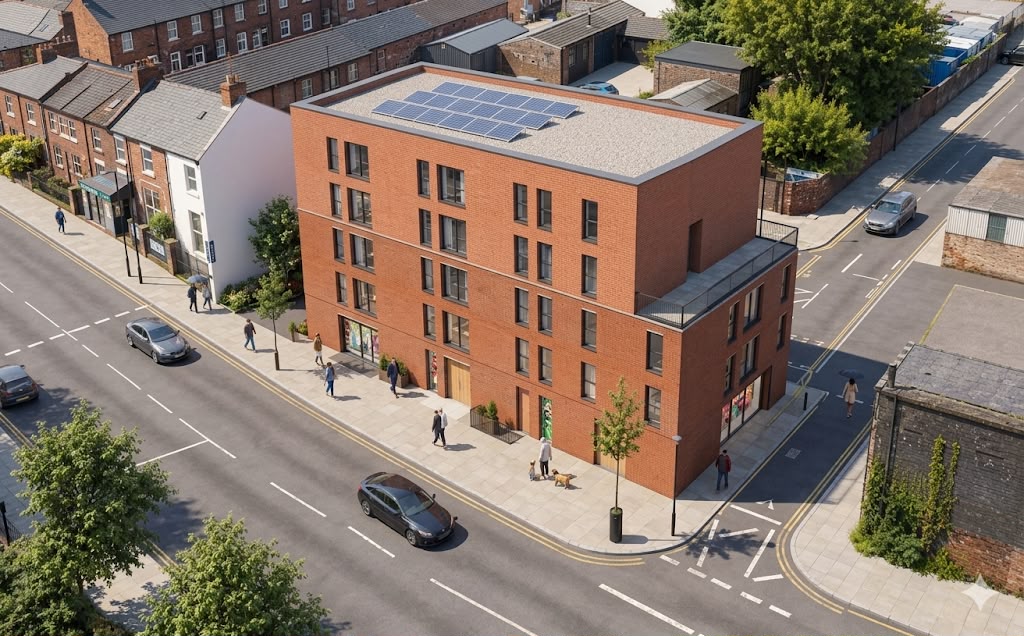
The outcome was a defined proposition: a stepped, new-build apartment scheme rising to six storeys – 11 homes, sized and shaped to suit the site rather than forced onto it.
That gave the developer something a spreadsheet never could: a design-led, evidence-based picture of the site's real potential.
But "a defined proposition" is doing a lot of work in that sentence. What did it actually involve?
Feasibility isn't the question of whether the numbers work. It's the question of which numbers are even possible. That answer is drawn before it's calculated.
What we actually saw on the site
This is where feasibility earns its fee – and where it stops being a formality. A genuine assessment isn't a yes/no; it's a set of design judgements that determine everything downstream:
Capacity, honestly read. Not the most units the plot could theoretically take, but the most it can carry well, because over-developed schemes invite refusal, and under-developed ones leave value in the ground. On Uttoxeter Road, that meant resolving massing against the surrounding context rather than maximising it in isolation – stepping the building down to three storeys along its western edge, where it meets the one and two-storey neighbours, and concentrating its height on the eastern, town-centre corner where the townscape can carry it. The height went where the context could absorb it, not simply where the floorplate allowed it.
The constraint that becomes the opportunity. Most sites have an awkward feature – a level change, an odd boundary, a sightline – that a spreadsheet treats as a problem and good design treats as a brief. Here it was the site's own prominence: a corner plot at a two-street junction, on rising ground, within the Longton conservation area and directly opposite a listed building. A calculator reads all of that as risk. We read it as a brief – the chance to turn a long-empty, awkward corner into a frontage that contributes to the street rather than turning its back on it.
Efficiency where it pays. Sensible cores, circulation that doesn't waste lettable area, and unit layouts that work – because on a development site, wasted square metres are wasted value, repeated on every floor.
Every one of those is a design decision. None of them lives in a viability appraisal. They precede it.
Which meant the real test hadn't happened yet. The drawings were one thing - the planners were another.
Gift break
Are you weighing up a site of your own? Before you make an offer, it's worth running it through the same questions we did – our free Pre-Acquisition Feasibility Checklist walks you through them, stage by stage.
Here is the conversation most developers skip
Buying the land was the start of de-risking the project, not the end of it.
Before developing the full proposal, we carried out a pre-application enquiry with Stoke-on-Trent City Council – a structured way of putting an emerging scheme in front of the local authority before significant time and cost go into a formal application.
The council came back with feedback, and rather than treating it as a hurdle, we treated it as information. They were engaged but exacting - supportive of the principle of bringing a long-empty site back into use, but with clear views on height, massing, the building's relationship to the conservation area, and how the ground floor meets the street. Rather than treat that as a setback, we treated it as exactly the information the pre-application stage exists to surface, and it directly shaped how the scheme was refined before a formal application was ever submitted: a more contextual response to scale, and a harder look at the building at eye level.
That's the part most developers never see - and it's the part that turns a planning application from a gamble into a conversation you've already half-had.
And here is what changed for the developer
By running the work in this sequence - design-led feasibility first, an informed purchase second, and early council engagement third - the developer ended up with three things that are difficult to put a price on:
Confidence at the point of purchase, built on a drawn understanding of the site rather than an assumed one.
A scheme working with its context and policy, rather than fighting both - the difference between a good planning journey and a contested one.
Far less planning uncertainty, because the council's view was understood early and built into the design from the outset.
We've since developed the full planning application proposal for the scheme – designed throughout with planning policy considered from day one, as our TRUST process requires, with the core design package delivered within five weeks.
None of that happened because of a clever spreadsheet. It happened because someone picked up a pencil before they picked up a calculator.
Why this view is worth weighing
Studio Tashkeel is a Manchester-based architectural practice founded in 2017, with 400+ completed projects across residential, commercial and mixed-use development throughout the North West. The practice was founded by Muthahar Khan, following years of award-winning experience, including Zaha Hadid Architects, and project leadership on internationally recognised schemes such as the MCFC Community Stadium with Rafael Viñoly Architects. Our core focus is singular: adding real value to property assets through strong design and efficient spatial planning.
That focus is why we see feasibility the way we do - not as a gate to pass, but as the single highest-leverage decision in the entire development.
The lesson from Uttoxeter Road
It isn't complicated, but it's easy to skip under deal pressure: understand what a site can deliver - by design - before you commit to it.
Feasibility is the earliest, cheapest and most powerful point at which anyone can influence a development's outcome. It's where an architect adds the most value: not at the end, dressing up a scheme, but at the start, defining whether there's a scheme worth having at all.
The developers who treat that moment as a design decision, rather than a spreadsheet, are the ones who stop being surprised by their own sites.
The question is what your next site is hiding – and whether you'll find out before you buy it, or after.
Have a specific site in mind?
If you're weighing up an acquisition in the North West and want a design-led read on what it could deliver, we'd be glad to talk it through.
Prefer to start with a self-check first? Grab our free Pre-Acquisition Feasibility Checklist — the same five-stage process we used on Uttoxeter Road.
By Studio Tashkeel Architecture - a planning-led architectural design practice founded in 2017, with 400+ completed projects across the North West.
Ask most developers what a feasibility study is, and you'll get some version of the same answer: a check on whether the numbers work. Costs in one column, values in another, and a margin at the bottom. If the margin survives, the site is "feasible".
That definition is why so many sites disappoint after an exchange – and the reason has nothing to do with the numbers themselves.
The spreadsheet was never the problem
The spreadsheet doesn't tell you what you can build. It assumes an answer to that question and then does arithmetic on top of it. And the assumption - how many homes, what massing, what the planners will accept - is an architectural judgement, not a financial one. Get it wrong by a single storey or a handful of units, and every figure beneath it is wrong too.
Which raises the obvious question: if the most important number in the whole appraisal is actually a design decision, why is it usually the one nobody designs?
This is the story of a site on Uttoxeter Road in Stoke-on-Trent, where a North West developer asked the question in a different order - what can this land actually deliver? - before asking what it would be worth. What he got back changed the shape of the deal entirely.
The category error that costs developers the most
At times, the site looks promising. And the plot is the right size, the location stacks up, and the pressure to move is real because good sites do not sit around. So you get tempted to run the numbers, trust the margin, and proceed.
But "promising" and "viable" are different things – and only one of them can be confirmed with a calculator. A plot's real capacity is governed by planning policy, context, access, daylight, massing and a dozen design constraints that don't appear on a spreadsheet, because they have to be drawn before they can be known.
Skip the drawing, and you haven't bought a development. You've bought a hypothesis with a confident-looking number attached.
The developer on Uttoxeter Road chose not to buy a hypothesis. Here's what he did instead.
The brief: a piece of land, and an open question
Our client came to us with the site before committing to it and asked the only question worth asking first: What can I build here, and is it worth pursuing?'
Rather than start from a desired answer and work backwards, we started from the site itself. We tested it against Stoke-on-Trent's local planning policy, read its context and constraints, and asked what good design could responsibly draw out of it. This is Stage 2 of our Pre-Acquisition Framework - see the 3/6 questions breakdown on our LinkedIn.
The outcome was a defined proposition: a stepped, new-build apartment scheme rising to six storeys – 11 homes, sized and shaped to suit the site rather than forced onto it.
That gave the developer something a spreadsheet never could: a design-led, evidence-based picture of the site's real potential.
But "a defined proposition" is doing a lot of work in that sentence. What did it actually involve?
Feasibility isn't the question of whether the numbers work. It's the question of which numbers are even possible. That answer is drawn before it's calculated.
What we actually saw on the site
This is where feasibility earns its fee – and where it stops being a formality. A genuine assessment isn't a yes/no; it's a set of design judgements that determine everything downstream:
Capacity, honestly read. Not the most units the plot could theoretically take, but the most it can carry well, because over-developed schemes invite refusal, and under-developed ones leave value in the ground. On Uttoxeter Road, that meant resolving massing against the surrounding context rather than maximising it in isolation – stepping the building down to three storeys along its western edge, where it meets the one and two-storey neighbours, and concentrating its height on the eastern, town-centre corner where the townscape can carry it. The height went where the context could absorb it, not simply where the floorplate allowed it.
The constraint that becomes the opportunity. Most sites have an awkward feature – a level change, an odd boundary, a sightline – that a spreadsheet treats as a problem and good design treats as a brief. Here it was the site's own prominence: a corner plot at a two-street junction, on rising ground, within the Longton conservation area and directly opposite a listed building. A calculator reads all of that as risk. We read it as a brief – the chance to turn a long-empty, awkward corner into a frontage that contributes to the street rather than turning its back on it.
Efficiency where it pays. Sensible cores, circulation that doesn't waste lettable area, and unit layouts that work – because on a development site, wasted square metres are wasted value, repeated on every floor.
Every one of those is a design decision. None of them lives in a viability appraisal. They precede it.
Which meant the real test hadn't happened yet. The drawings were one thing - the planners were another.
Gift break
Are you weighing up a site of your own? Before you make an offer, it's worth running it through the same questions we did – our free Pre-Acquisition Feasibility Checklist walks you through them, stage by stage.
Here is the conversation most developers skip
Buying the land was the start of de-risking the project, not the end of it.
Before developing the full proposal, we carried out a pre-application enquiry with Stoke-on-Trent City Council – a structured way of putting an emerging scheme in front of the local authority before significant time and cost go into a formal application.
The council came back with feedback, and rather than treating it as a hurdle, we treated it as information. They were engaged but exacting - supportive of the principle of bringing a long-empty site back into use, but with clear views on height, massing, the building's relationship to the conservation area, and how the ground floor meets the street. Rather than treat that as a setback, we treated it as exactly the information the pre-application stage exists to surface, and it directly shaped how the scheme was refined before a formal application was ever submitted: a more contextual response to scale, and a harder look at the building at eye level.
That's the part most developers never see - and it's the part that turns a planning application from a gamble into a conversation you've already half-had.
And here is what changed for the developer
By running the work in this sequence - design-led feasibility first, an informed purchase second, and early council engagement third - the developer ended up with three things that are difficult to put a price on:
Confidence at the point of purchase, built on a drawn understanding of the site rather than an assumed one.
A scheme working with its context and policy, rather than fighting both - the difference between a good planning journey and a contested one.
Far less planning uncertainty, because the council's view was understood early and built into the design from the outset.
We've since developed the full planning application proposal for the scheme – designed throughout with planning policy considered from day one, as our TRUST process requires, with the core design package delivered within five weeks.
None of that happened because of a clever spreadsheet. It happened because someone picked up a pencil before they picked up a calculator.
Why this view is worth weighing
Studio Tashkeel is a Manchester-based architectural practice founded in 2017, with 400+ completed projects across residential, commercial and mixed-use development throughout the North West. The practice was founded by Muthahar Khan, following years of award-winning experience, including Zaha Hadid Architects, and project leadership on internationally recognised schemes such as the MCFC Community Stadium with Rafael Viñoly Architects. Our core focus is singular: adding real value to property assets through strong design and efficient spatial planning.
That focus is why we see feasibility the way we do - not as a gate to pass, but as the single highest-leverage decision in the entire development.
The lesson from Uttoxeter Road
It isn't complicated, but it's easy to skip under deal pressure: understand what a site can deliver - by design - before you commit to it.
Feasibility is the earliest, cheapest and most powerful point at which anyone can influence a development's outcome. It's where an architect adds the most value: not at the end, dressing up a scheme, but at the start, defining whether there's a scheme worth having at all.
The developers who treat that moment as a design decision, rather than a spreadsheet, are the ones who stop being surprised by their own sites.
The question is what your next site is hiding – and whether you'll find out before you buy it, or after.
Have a specific site in mind?
If you're weighing up an acquisition in the North West and want a design-led read on what it could deliver, we'd be glad to talk it through.
Prefer to start with a self-check first? Grab our free Pre-Acquisition Feasibility Checklist — the same five-stage process we used on Uttoxeter Road.
By Studio Tashkeel Architecture - a planning-led architectural design practice founded in 2017, with 400+ completed projects across the North West.
Ask most developers what a feasibility study is, and you'll get some version of the same answer: a check on whether the numbers work. Costs in one column, values in another, and a margin at the bottom. If the margin survives, the site is "feasible".
That definition is why so many sites disappoint after an exchange – and the reason has nothing to do with the numbers themselves.
The spreadsheet was never the problem
The spreadsheet doesn't tell you what you can build. It assumes an answer to that question and then does arithmetic on top of it. And the assumption - how many homes, what massing, what the planners will accept - is an architectural judgement, not a financial one. Get it wrong by a single storey or a handful of units, and every figure beneath it is wrong too.
Which raises the obvious question: if the most important number in the whole appraisal is actually a design decision, why is it usually the one nobody designs?
This is the story of a site on Uttoxeter Road in Stoke-on-Trent, where a North West developer asked the question in a different order - what can this land actually deliver? - before asking what it would be worth. What he got back changed the shape of the deal entirely.
The category error that costs developers the most
At times, the site looks promising. And the plot is the right size, the location stacks up, and the pressure to move is real because good sites do not sit around. So you get tempted to run the numbers, trust the margin, and proceed.
But "promising" and "viable" are different things – and only one of them can be confirmed with a calculator. A plot's real capacity is governed by planning policy, context, access, daylight, massing and a dozen design constraints that don't appear on a spreadsheet, because they have to be drawn before they can be known.
Skip the drawing, and you haven't bought a development. You've bought a hypothesis with a confident-looking number attached.
The developer on Uttoxeter Road chose not to buy a hypothesis. Here's what he did instead.
The brief: a piece of land, and an open question
Our client came to us with the site before committing to it and asked the only question worth asking first: What can I build here, and is it worth pursuing?'
Rather than start from a desired answer and work backwards, we started from the site itself. We tested it against Stoke-on-Trent's local planning policy, read its context and constraints, and asked what good design could responsibly draw out of it. This is Stage 2 of our Pre-Acquisition Framework - see the 3/6 questions breakdown on our LinkedIn.
The outcome was a defined proposition: a stepped, new-build apartment scheme rising to six storeys – 11 homes, sized and shaped to suit the site rather than forced onto it.
That gave the developer something a spreadsheet never could: a design-led, evidence-based picture of the site's real potential.
But "a defined proposition" is doing a lot of work in that sentence. What did it actually involve?
Feasibility isn't the question of whether the numbers work. It's the question of which numbers are even possible. That answer is drawn before it's calculated.
What we actually saw on the site
This is where feasibility earns its fee – and where it stops being a formality. A genuine assessment isn't a yes/no; it's a set of design judgements that determine everything downstream:
Capacity, honestly read. Not the most units the plot could theoretically take, but the most it can carry well, because over-developed schemes invite refusal, and under-developed ones leave value in the ground. On Uttoxeter Road, that meant resolving massing against the surrounding context rather than maximising it in isolation – stepping the building down to three storeys along its western edge, where it meets the one and two-storey neighbours, and concentrating its height on the eastern, town-centre corner where the townscape can carry it. The height went where the context could absorb it, not simply where the floorplate allowed it.
The constraint that becomes the opportunity. Most sites have an awkward feature – a level change, an odd boundary, a sightline – that a spreadsheet treats as a problem and good design treats as a brief. Here it was the site's own prominence: a corner plot at a two-street junction, on rising ground, within the Longton conservation area and directly opposite a listed building. A calculator reads all of that as risk. We read it as a brief – the chance to turn a long-empty, awkward corner into a frontage that contributes to the street rather than turning its back on it.
Efficiency where it pays. Sensible cores, circulation that doesn't waste lettable area, and unit layouts that work – because on a development site, wasted square metres are wasted value, repeated on every floor.
Every one of those is a design decision. None of them lives in a viability appraisal. They precede it.
Which meant the real test hadn't happened yet. The drawings were one thing - the planners were another.
Gift break
Are you weighing up a site of your own? Before you make an offer, it's worth running it through the same questions we did – our free Pre-Acquisition Feasibility Checklist walks you through them, stage by stage.
Here is the conversation most developers skip
Buying the land was the start of de-risking the project, not the end of it.
Before developing the full proposal, we carried out a pre-application enquiry with Stoke-on-Trent City Council – a structured way of putting an emerging scheme in front of the local authority before significant time and cost go into a formal application.
The council came back with feedback, and rather than treating it as a hurdle, we treated it as information. They were engaged but exacting - supportive of the principle of bringing a long-empty site back into use, but with clear views on height, massing, the building's relationship to the conservation area, and how the ground floor meets the street. Rather than treat that as a setback, we treated it as exactly the information the pre-application stage exists to surface, and it directly shaped how the scheme was refined before a formal application was ever submitted: a more contextual response to scale, and a harder look at the building at eye level.
That's the part most developers never see - and it's the part that turns a planning application from a gamble into a conversation you've already half-had.
And here is what changed for the developer
By running the work in this sequence - design-led feasibility first, an informed purchase second, and early council engagement third - the developer ended up with three things that are difficult to put a price on:
Confidence at the point of purchase, built on a drawn understanding of the site rather than an assumed one.
A scheme working with its context and policy, rather than fighting both - the difference between a good planning journey and a contested one.
Far less planning uncertainty, because the council's view was understood early and built into the design from the outset.
We've since developed the full planning application proposal for the scheme – designed throughout with planning policy considered from day one, as our TRUST process requires, with the core design package delivered within five weeks.
None of that happened because of a clever spreadsheet. It happened because someone picked up a pencil before they picked up a calculator.
Why this view is worth weighing
Studio Tashkeel is a Manchester-based architectural practice founded in 2017, with 400+ completed projects across residential, commercial and mixed-use development throughout the North West. The practice was founded by Muthahar Khan, following years of award-winning experience, including Zaha Hadid Architects, and project leadership on internationally recognised schemes such as the MCFC Community Stadium with Rafael Viñoly Architects. Our core focus is singular: adding real value to property assets through strong design and efficient spatial planning.
That focus is why we see feasibility the way we do - not as a gate to pass, but as the single highest-leverage decision in the entire development.
The lesson from Uttoxeter Road
It isn't complicated, but it's easy to skip under deal pressure: understand what a site can deliver - by design - before you commit to it.
Feasibility is the earliest, cheapest and most powerful point at which anyone can influence a development's outcome. It's where an architect adds the most value: not at the end, dressing up a scheme, but at the start, defining whether there's a scheme worth having at all.
The developers who treat that moment as a design decision, rather than a spreadsheet, are the ones who stop being surprised by their own sites.
The question is what your next site is hiding – and whether you'll find out before you buy it, or after.
Have a specific site in mind?
If you're weighing up an acquisition in the North West and want a design-led read on what it could deliver, we'd be glad to talk it through.
Prefer to start with a self-check first? Grab our free Pre-Acquisition Feasibility Checklist — the same five-stage process we used on Uttoxeter Road.
Continue Reading
Explore ideas, trends, and behind-the-scenes stories from our studio.