Permitted Development vs Full Planning: Which Route is Better for ROI on Commercial Conversions?
Key Takeaways
Permitted Development is faster but constrained by the existing building envelope and the limited scope of prior approval assessment.
Full Planning Permission is slower but unlocks design flexibility, additional storeys, facade alterations, and listed building works.
The route decision changes the entire financial model. Cost, timescale, unit count, end value, and risk profile all shift depending on which route is chosen.
Article 4 directions can remove the choice. Where the local authority has restricted Permitted Development rights, full planning becomes the only available route.
A hybrid submission strategy is often the strongest position. Submitting a Permitted Development prior approval as a fallback while pursuing full planning in parallel protects the floor under the appraisal and unlocks the upside.
The right route is project-specific. It depends on the building, the location, the appraisal logic, and the developer's exit strategy.
Why This Decision Matters
The planning route is not a procedural detail. It is one of the most consequential decisions made on a commercial conversion scheme, and most developers make it too quickly.
The default assumption is that Permitted Development is the faster, cheaper, easier route, and therefore the better one. That assumption is often wrong. PD constrains what the building can become, which means it can constrain the end value of the scheme. Full Planning takes longer and costs more to consent, but in the right building it produces a materially stronger commercial outcome.
The right route depends on what the building is, where it sits, what the developer is trying to achieve, and how the financial model stacks up under each scenario. This article walks through the comparison and the decision logic.
What Permitted Development Actually Delivers
Permitted Development is a national grant of planning permission that allows certain changes of use without a full planning application. For commercial-to-residential conversions, the most common route is Class MA, which allows buildings in Use Class E (offices, shops, restaurants, gyms, nurseries, healthcare, light industrial) to convert to residential under prior approval.
Prior approval is a limited form of planning assessment. The local authority issues a decision within 56 days and reviews specific matters only: transport impacts, contamination risks, flood risk, noise, natural light, space standards, and fire safety for buildings above 18 metres or seven storeys. Wider planning considerations, including local plan policies, design quality, and affordable housing contributions, are not part of the assessment.
The result is a faster and more certain consenting process, but one that works within the existing building envelope. The conversion must use the building broadly as it stands, with limited scope for external alterations.
For a full primer on the Permitted Development routes available for commercial conversions, see How to Turn Vacant Commercial Assets into High-Yield Residential Apartments.
What Full Planning Permission Delivers
Full Planning Permission is the standard route for development that falls outside Permitted Development, or where the scheme is more ambitious than a simple change of use within the existing envelope.
The timescale is longer. Most full planning applications take 8 to 13 weeks for a decision, and complex schemes routinely take 6 to 12 months once pre-application discussions, consultation, design panel review, and committee scheduling are factored in. The cost of consenting is higher, both in application fees and in the consultant input required to produce the supporting documents.
In exchange, full planning unlocks flexibility. External alterations are permitted. Additional storeys can be added through rooftop extensions. The building footprint can be reconfigured. Listed building consent can be applied for in parallel. The scheme can be designed around what the market wants, rather than around what the existing building allows.
Full planning also exposes the scheme to wider policy considerations. Affordable housing contributions, Section 106 obligations, Community Infrastructure Levy on new floorspace, design panel review, and discretionary planning officer judgement all come into play. The trade-off is flexibility for friction.
The Comparison That Actually Matters
The factors below are the ones that determine the financial outcome of the scheme. Dave should read this as a decision matrix, not a procedural summary.
Factor | Permitted Development | Full Planning |
|---|---|---|
Decision timescale | 56 days | 8 to 13 weeks (often longer in practice) |
External alterations | Limited | Permitted |
Additional storeys | Generally not permitted | Achievable through design |
Unit count flexibility | Constrained by existing envelope | Can be increased through design |
Affordable housing requirement | None | Often required above local threshold |
CIL liability | Reduced (existing floorspace deductible) | Full liability on new floorspace |
Section 106 obligations | None | Often applicable |
Pre-application advice | Not required | Often advisable |
Design panel review | Not applicable | Frequently required |
Article 4 risk | Can remove the right entirely | Not affected |
Listed building suitability | Excluded | Required route |
Cost of consenting | Lower | Higher |
Certainty of outcome | Higher within scope | Lower, more discretionary |
This table is the heart of the decision. Each row carries direct financial implications, and the right route is the one where the balance of these factors produces the strongest risk-adjusted return for the specific scheme.
When Permitted Development Is the Right Route
Permitted Development is the right route when the building is well-suited to conversion within its existing envelope, the unit yield works without external alterations, and the appraisal does not depend on increased floorspace.
In practice, this means a clean Class E asset, typically a secondary office, retail unit, or mixed commercial building, where the floor plate, daylight, and structural grid allow for a sensible residential layout. The building is not listed. The site is not subject to an Article 4 direction. The local authority has a reasonable track record on prior approval decisions.
Where these conditions align, PD delivers speed and certainty. The 56-day decision window means the developer can move from acquisition to consent in under three months, which materially affects holding costs and finance drawdowns. The reduced scope of assessment means fewer points of discretionary judgment and fewer opportunities for the scheme to be challenged or delayed.
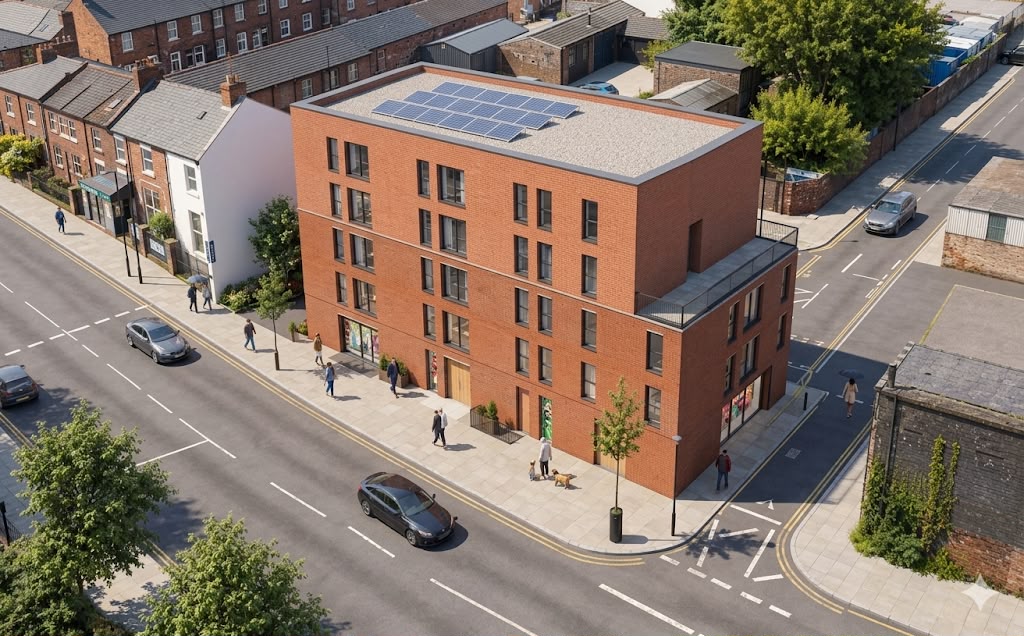
The illustrative pattern looks like this. A developer acquires a 1,200 sqm Class E office building in a regional North West city for around £900,000. The building converts cleanly into 14 apartments within the existing envelope. Prior approval is secured in 8 weeks. Construction begins in month 4. The end valuation, at standard regional specification, sits in the £2.8 million range. The financial logic works, the timeline is fast, and the planning risk is contained.
When Full Planning Is the Right Route
Full Planning is the right route when the scheme requires design flexibility that Permitted Development cannot provide, or when the existing building envelope is leaving value on the table.
The clearest case is where the building can support additional storeys through a rooftop extension. PD does not allow this. Full planning does. On a four-storey commercial building with structural capacity for a fifth floor, the additional 25% in floorspace can transform the financial model. The same logic applies to facade alterations that improve daylight, layouts that improve the unit mix, and design moves that materially affect the end valuation.
Full planning is also the only route for listed buildings, schemes within Article 4 areas, and conversions where the local authority has otherwise restricted PD rights. In these cases the decision is made for the developer, and the question becomes how to optimise the full planning submission rather than whether to use it.
The illustrative pattern here looks like this. The same 1,200 sqm office building, same acquisition price, but the developer pursues full planning with a rooftop extension. The scheme delivers 18 apartments instead of 14. Planning permission is secured in 9 months. Construction begins in month 11. The end valuation, at standard regional specification, sits in the £3.6 million range. The additional 7 months of timeline and the additional cost of CIL and Section 106 are absorbed by the uplift in unit count and end value.
These two scenarios produce very different financial outcomes on the same building. Neither is universally correct. The right route is the one where the appraisal works best after every cost and timescale variable is properly modelled.
The Hybrid Route Most Developers Miss
The strongest commercial position is often neither pure Permitted Development nor pure full planning. It is both, submitted in parallel.
Here is how it works. The developer submits a Permitted Development prior approval as a fallback position, securing the basic conversion rights within 56 days. At the same time, the developer submits a full planning application for the more ambitious scheme. If full planning succeeds, the developer builds a better scheme and discards the PD consent. If full planning fails or is delayed beyond an acceptable point, the developer reverts to the PD consent and proceeds with the safer scheme.
This protects the floor under the appraisal. The PD consent guarantees that the developer can deliver at least the baseline scheme, which protects the acquisition decision. The full planning application then operates as upside, not as risk.
Most developers do not run this strategy because their planning consultant is paid to submit one application, not two, and the additional consultant fees feel like a duplicate cost. In reality, the cost of the second submission is small relative to the financial protection it provides on a £900k-plus acquisition. Dave's planning team should be advising on this strategy at the feasibility stage, and if they are not, that is a signal about the quality of the advice he is receiving.
Article 4 Directions: The Risk That Removes Your Choice
Local authorities can withdraw Permitted Development rights in specific areas through what is called an Article 4 direction. The number of these has grown significantly since Class MA was introduced, particularly in central London boroughs, university cities, and town centres where the council wants to protect commercial floorspace from being lost to residential conversion.
If a building sits within an Article 4 area, the relevant PD route does not apply, and full planning becomes the only available route. The financial implications are significant. Article 4 status removes the option of the 56-day decision, removes the option of the hybrid submission strategy, and exposes the scheme to the full weight of local planning policy.
Article 4 checks should be the first thing done at acquisition stage, before any deal is signed. The cheapest way to lose money on a conversion is to acquire a building assuming PD applies, and discover after exchange that an Article 4 direction has removed the right.
Common Mistakes in Choosing the Wrong Route
The most frequent error is choosing Permitted Development because it sounds faster, when the scheme genuinely needs the design flexibility that only full planning can deliver. The result is a converted building that meets prior approval requirements but underperforms commercially because the unit mix, the floor plate efficiency, or the facade quality is constrained by what the existing envelope allows.
The opposite error is also common. Developers pursue full planning out of habit or consultant preference, when Permitted Development would have delivered the same end product with significantly less friction. The additional 6 to 9 months on the timeline and the additional Section 106 and CIL exposure are absorbed without any meaningful uplift in end value.
The third error is treating the route as a binary decision. The hybrid submission strategy is widely underused, and most developers do not realise it is available. A planning consultant who recommends only one route without modelling the alternative is providing incomplete advice.
The fourth error is failing to check Article 4 status before acquisition. This is the single most expensive mistake on the list, because it can invalidate the entire acquisition logic after the deal has exchanged.
How Studio Tashkeel Architecture Approaches the Route Decision
Studio Tashkeel Architecture tests both planning routes at feasibility stage as standard, before the building is acquired. We model the financial implications of each route alongside the design, so the developer can see how the appraisal performs under PD, under full planning, and under a hybrid submission strategy.
We are not tied to one route ideologically. The right answer is the one that delivers the strongest risk-adjusted return for the developer on the specific building, in the specific location, with the specific exit strategy. Sometimes that is Permitted Development. Sometimes that is full planning. More often than developers realise, it is both.
The discipline that holds this together is the single point of contact delivery model. The planning, design, and commercial logic are aligned from the first feasibility review, which means the developer is not coordinating three different consultants giving three different answers. The answer comes from one team that is responsible for the outcome.
Frequently Asked Questions
What is the main difference between Permitted Development and full planning?
Permitted Development is a national grant of planning permission for specific changes of use, subject to prior approval on a limited set of issues. Full planning is a discretionary application assessed against local planning policy and a wider range of considerations. PD is faster and more certain within its scope. Full planning is slower and more discretionary but offers greater design flexibility.
Which route is faster?
Permitted Development is faster. A prior approval decision is issued within 56 days. A full planning decision typically takes 8 to 13 weeks for straightforward applications, and 6 to 12 months for complex schemes once pre-application, consultation, and committee scheduling are factored in.
Can I submit both routes at the same time?
Yes. A hybrid submission strategy involves submitting a Permitted Development prior approval as a fallback while pursuing full planning in parallel. The PD consent protects the baseline scheme. The full planning application targets the upside. This is one of the most effective ways to manage planning risk on a commercial conversion.
Does Permitted Development always result in lower-quality outcomes?
Not always, but it can. The constraints of working within the existing envelope, combined with the limited assessment scope, mean that PD conversions are sometimes designed to meet the rules rather than to meet the market. Whether this matters depends on the building and the exit strategy. Where the existing envelope already supports a strong scheme, PD delivers good outcomes. Where the envelope is constraining the design, full planning produces better results.
What happens if my building sits within an Article 4 direction?
The Permitted Development right does not apply, and full planning becomes the only available route. This must be checked before acquisition, because Article 4 status materially changes the cost, timescale, and risk profile of the scheme.
Does Permitted Development trigger CIL or Section 106?
CIL liability is reduced under Permitted Development because existing commercial floorspace can be deducted from the chargeable amount. Section 106 obligations do not apply to PD conversions, because the prior approval process does not assess policy compliance. Full planning typically triggers both, depending on the scheme size and the local authority's policies.
Which route should I choose for a listed commercial building?
Listed buildings are excluded from Permitted Development, so full planning is the required route. Listed building consent is required alongside the planning application, which adds time and consultant input but is unavoidable for listed assets.
Ready to Assess the Right Route for Your Scheme?
If you are evaluating a commercial building for conversion to residential and want a structured route assessment that models both Permitted Development and full planning before you commit to acquisition, Studio Tashkeel Architecture can provide a feasibility review aligned to your timeline.
Visit our Commercial clients page →
Further Reading
Key Takeaways
Permitted Development is faster but constrained by the existing building envelope and the limited scope of prior approval assessment.
Full Planning Permission is slower but unlocks design flexibility, additional storeys, facade alterations, and listed building works.
The route decision changes the entire financial model. Cost, timescale, unit count, end value, and risk profile all shift depending on which route is chosen.
Article 4 directions can remove the choice. Where the local authority has restricted Permitted Development rights, full planning becomes the only available route.
A hybrid submission strategy is often the strongest position. Submitting a Permitted Development prior approval as a fallback while pursuing full planning in parallel protects the floor under the appraisal and unlocks the upside.
The right route is project-specific. It depends on the building, the location, the appraisal logic, and the developer's exit strategy.
Why This Decision Matters
The planning route is not a procedural detail. It is one of the most consequential decisions made on a commercial conversion scheme, and most developers make it too quickly.
The default assumption is that Permitted Development is the faster, cheaper, easier route, and therefore the better one. That assumption is often wrong. PD constrains what the building can become, which means it can constrain the end value of the scheme. Full Planning takes longer and costs more to consent, but in the right building it produces a materially stronger commercial outcome.
The right route depends on what the building is, where it sits, what the developer is trying to achieve, and how the financial model stacks up under each scenario. This article walks through the comparison and the decision logic.
What Permitted Development Actually Delivers
Permitted Development is a national grant of planning permission that allows certain changes of use without a full planning application. For commercial-to-residential conversions, the most common route is Class MA, which allows buildings in Use Class E (offices, shops, restaurants, gyms, nurseries, healthcare, light industrial) to convert to residential under prior approval.
Prior approval is a limited form of planning assessment. The local authority issues a decision within 56 days and reviews specific matters only: transport impacts, contamination risks, flood risk, noise, natural light, space standards, and fire safety for buildings above 18 metres or seven storeys. Wider planning considerations, including local plan policies, design quality, and affordable housing contributions, are not part of the assessment.
The result is a faster and more certain consenting process, but one that works within the existing building envelope. The conversion must use the building broadly as it stands, with limited scope for external alterations.
For a full primer on the Permitted Development routes available for commercial conversions, see How to Turn Vacant Commercial Assets into High-Yield Residential Apartments.
What Full Planning Permission Delivers
Full Planning Permission is the standard route for development that falls outside Permitted Development, or where the scheme is more ambitious than a simple change of use within the existing envelope.
The timescale is longer. Most full planning applications take 8 to 13 weeks for a decision, and complex schemes routinely take 6 to 12 months once pre-application discussions, consultation, design panel review, and committee scheduling are factored in. The cost of consenting is higher, both in application fees and in the consultant input required to produce the supporting documents.
In exchange, full planning unlocks flexibility. External alterations are permitted. Additional storeys can be added through rooftop extensions. The building footprint can be reconfigured. Listed building consent can be applied for in parallel. The scheme can be designed around what the market wants, rather than around what the existing building allows.
Full planning also exposes the scheme to wider policy considerations. Affordable housing contributions, Section 106 obligations, Community Infrastructure Levy on new floorspace, design panel review, and discretionary planning officer judgement all come into play. The trade-off is flexibility for friction.
The Comparison That Actually Matters
The factors below are the ones that determine the financial outcome of the scheme. Dave should read this as a decision matrix, not a procedural summary.
Factor | Permitted Development | Full Planning |
|---|---|---|
Decision timescale | 56 days | 8 to 13 weeks (often longer in practice) |
External alterations | Limited | Permitted |
Additional storeys | Generally not permitted | Achievable through design |
Unit count flexibility | Constrained by existing envelope | Can be increased through design |
Affordable housing requirement | None | Often required above local threshold |
CIL liability | Reduced (existing floorspace deductible) | Full liability on new floorspace |
Section 106 obligations | None | Often applicable |
Pre-application advice | Not required | Often advisable |
Design panel review | Not applicable | Frequently required |
Article 4 risk | Can remove the right entirely | Not affected |
Listed building suitability | Excluded | Required route |
Cost of consenting | Lower | Higher |
Certainty of outcome | Higher within scope | Lower, more discretionary |
This table is the heart of the decision. Each row carries direct financial implications, and the right route is the one where the balance of these factors produces the strongest risk-adjusted return for the specific scheme.
When Permitted Development Is the Right Route
Permitted Development is the right route when the building is well-suited to conversion within its existing envelope, the unit yield works without external alterations, and the appraisal does not depend on increased floorspace.
In practice, this means a clean Class E asset, typically a secondary office, retail unit, or mixed commercial building, where the floor plate, daylight, and structural grid allow for a sensible residential layout. The building is not listed. The site is not subject to an Article 4 direction. The local authority has a reasonable track record on prior approval decisions.
Where these conditions align, PD delivers speed and certainty. The 56-day decision window means the developer can move from acquisition to consent in under three months, which materially affects holding costs and finance drawdowns. The reduced scope of assessment means fewer points of discretionary judgment and fewer opportunities for the scheme to be challenged or delayed.
The illustrative pattern looks like this. A developer acquires a 1,200 sqm Class E office building in a regional North West city for around £900,000. The building converts cleanly into 14 apartments within the existing envelope. Prior approval is secured in 8 weeks. Construction begins in month 4. The end valuation, at standard regional specification, sits in the £2.8 million range. The financial logic works, the timeline is fast, and the planning risk is contained.
When Full Planning Is the Right Route
Full Planning is the right route when the scheme requires design flexibility that Permitted Development cannot provide, or when the existing building envelope is leaving value on the table.
The clearest case is where the building can support additional storeys through a rooftop extension. PD does not allow this. Full planning does. On a four-storey commercial building with structural capacity for a fifth floor, the additional 25% in floorspace can transform the financial model. The same logic applies to facade alterations that improve daylight, layouts that improve the unit mix, and design moves that materially affect the end valuation.
Full planning is also the only route for listed buildings, schemes within Article 4 areas, and conversions where the local authority has otherwise restricted PD rights. In these cases the decision is made for the developer, and the question becomes how to optimise the full planning submission rather than whether to use it.
The illustrative pattern here looks like this. The same 1,200 sqm office building, same acquisition price, but the developer pursues full planning with a rooftop extension. The scheme delivers 18 apartments instead of 14. Planning permission is secured in 9 months. Construction begins in month 11. The end valuation, at standard regional specification, sits in the £3.6 million range. The additional 7 months of timeline and the additional cost of CIL and Section 106 are absorbed by the uplift in unit count and end value.
These two scenarios produce very different financial outcomes on the same building. Neither is universally correct. The right route is the one where the appraisal works best after every cost and timescale variable is properly modelled.
The Hybrid Route Most Developers Miss
The strongest commercial position is often neither pure Permitted Development nor pure full planning. It is both, submitted in parallel.
Here is how it works. The developer submits a Permitted Development prior approval as a fallback position, securing the basic conversion rights within 56 days. At the same time, the developer submits a full planning application for the more ambitious scheme. If full planning succeeds, the developer builds a better scheme and discards the PD consent. If full planning fails or is delayed beyond an acceptable point, the developer reverts to the PD consent and proceeds with the safer scheme.
This protects the floor under the appraisal. The PD consent guarantees that the developer can deliver at least the baseline scheme, which protects the acquisition decision. The full planning application then operates as upside, not as risk.
Most developers do not run this strategy because their planning consultant is paid to submit one application, not two, and the additional consultant fees feel like a duplicate cost. In reality, the cost of the second submission is small relative to the financial protection it provides on a £900k-plus acquisition. Dave's planning team should be advising on this strategy at the feasibility stage, and if they are not, that is a signal about the quality of the advice he is receiving.
Article 4 Directions: The Risk That Removes Your Choice
Local authorities can withdraw Permitted Development rights in specific areas through what is called an Article 4 direction. The number of these has grown significantly since Class MA was introduced, particularly in central London boroughs, university cities, and town centres where the council wants to protect commercial floorspace from being lost to residential conversion.
If a building sits within an Article 4 area, the relevant PD route does not apply, and full planning becomes the only available route. The financial implications are significant. Article 4 status removes the option of the 56-day decision, removes the option of the hybrid submission strategy, and exposes the scheme to the full weight of local planning policy.
Article 4 checks should be the first thing done at acquisition stage, before any deal is signed. The cheapest way to lose money on a conversion is to acquire a building assuming PD applies, and discover after exchange that an Article 4 direction has removed the right.
Common Mistakes in Choosing the Wrong Route
The most frequent error is choosing Permitted Development because it sounds faster, when the scheme genuinely needs the design flexibility that only full planning can deliver. The result is a converted building that meets prior approval requirements but underperforms commercially because the unit mix, the floor plate efficiency, or the facade quality is constrained by what the existing envelope allows.
The opposite error is also common. Developers pursue full planning out of habit or consultant preference, when Permitted Development would have delivered the same end product with significantly less friction. The additional 6 to 9 months on the timeline and the additional Section 106 and CIL exposure are absorbed without any meaningful uplift in end value.
The third error is treating the route as a binary decision. The hybrid submission strategy is widely underused, and most developers do not realise it is available. A planning consultant who recommends only one route without modelling the alternative is providing incomplete advice.
The fourth error is failing to check Article 4 status before acquisition. This is the single most expensive mistake on the list, because it can invalidate the entire acquisition logic after the deal has exchanged.
How Studio Tashkeel Architecture Approaches the Route Decision
Studio Tashkeel Architecture tests both planning routes at feasibility stage as standard, before the building is acquired. We model the financial implications of each route alongside the design, so the developer can see how the appraisal performs under PD, under full planning, and under a hybrid submission strategy.
We are not tied to one route ideologically. The right answer is the one that delivers the strongest risk-adjusted return for the developer on the specific building, in the specific location, with the specific exit strategy. Sometimes that is Permitted Development. Sometimes that is full planning. More often than developers realise, it is both.
The discipline that holds this together is the single point of contact delivery model. The planning, design, and commercial logic are aligned from the first feasibility review, which means the developer is not coordinating three different consultants giving three different answers. The answer comes from one team that is responsible for the outcome.
Frequently Asked Questions
What is the main difference between Permitted Development and full planning?
Permitted Development is a national grant of planning permission for specific changes of use, subject to prior approval on a limited set of issues. Full planning is a discretionary application assessed against local planning policy and a wider range of considerations. PD is faster and more certain within its scope. Full planning is slower and more discretionary but offers greater design flexibility.
Which route is faster?
Permitted Development is faster. A prior approval decision is issued within 56 days. A full planning decision typically takes 8 to 13 weeks for straightforward applications, and 6 to 12 months for complex schemes once pre-application, consultation, and committee scheduling are factored in.
Can I submit both routes at the same time?
Yes. A hybrid submission strategy involves submitting a Permitted Development prior approval as a fallback while pursuing full planning in parallel. The PD consent protects the baseline scheme. The full planning application targets the upside. This is one of the most effective ways to manage planning risk on a commercial conversion.
Does Permitted Development always result in lower-quality outcomes?
Not always, but it can. The constraints of working within the existing envelope, combined with the limited assessment scope, mean that PD conversions are sometimes designed to meet the rules rather than to meet the market. Whether this matters depends on the building and the exit strategy. Where the existing envelope already supports a strong scheme, PD delivers good outcomes. Where the envelope is constraining the design, full planning produces better results.
What happens if my building sits within an Article 4 direction?
The Permitted Development right does not apply, and full planning becomes the only available route. This must be checked before acquisition, because Article 4 status materially changes the cost, timescale, and risk profile of the scheme.
Does Permitted Development trigger CIL or Section 106?
CIL liability is reduced under Permitted Development because existing commercial floorspace can be deducted from the chargeable amount. Section 106 obligations do not apply to PD conversions, because the prior approval process does not assess policy compliance. Full planning typically triggers both, depending on the scheme size and the local authority's policies.
Which route should I choose for a listed commercial building?
Listed buildings are excluded from Permitted Development, so full planning is the required route. Listed building consent is required alongside the planning application, which adds time and consultant input but is unavoidable for listed assets.
Ready to Assess the Right Route for Your Scheme?
If you are evaluating a commercial building for conversion to residential and want a structured route assessment that models both Permitted Development and full planning before you commit to acquisition, Studio Tashkeel Architecture can provide a feasibility review aligned to your timeline.
Visit our Commercial clients page →
Further Reading
Key Takeaways
Permitted Development is faster but constrained by the existing building envelope and the limited scope of prior approval assessment.
Full Planning Permission is slower but unlocks design flexibility, additional storeys, facade alterations, and listed building works.
The route decision changes the entire financial model. Cost, timescale, unit count, end value, and risk profile all shift depending on which route is chosen.
Article 4 directions can remove the choice. Where the local authority has restricted Permitted Development rights, full planning becomes the only available route.
A hybrid submission strategy is often the strongest position. Submitting a Permitted Development prior approval as a fallback while pursuing full planning in parallel protects the floor under the appraisal and unlocks the upside.
The right route is project-specific. It depends on the building, the location, the appraisal logic, and the developer's exit strategy.
Why This Decision Matters
The planning route is not a procedural detail. It is one of the most consequential decisions made on a commercial conversion scheme, and most developers make it too quickly.
The default assumption is that Permitted Development is the faster, cheaper, easier route, and therefore the better one. That assumption is often wrong. PD constrains what the building can become, which means it can constrain the end value of the scheme. Full Planning takes longer and costs more to consent, but in the right building it produces a materially stronger commercial outcome.
The right route depends on what the building is, where it sits, what the developer is trying to achieve, and how the financial model stacks up under each scenario. This article walks through the comparison and the decision logic.
What Permitted Development Actually Delivers
Permitted Development is a national grant of planning permission that allows certain changes of use without a full planning application. For commercial-to-residential conversions, the most common route is Class MA, which allows buildings in Use Class E (offices, shops, restaurants, gyms, nurseries, healthcare, light industrial) to convert to residential under prior approval.
Prior approval is a limited form of planning assessment. The local authority issues a decision within 56 days and reviews specific matters only: transport impacts, contamination risks, flood risk, noise, natural light, space standards, and fire safety for buildings above 18 metres or seven storeys. Wider planning considerations, including local plan policies, design quality, and affordable housing contributions, are not part of the assessment.
The result is a faster and more certain consenting process, but one that works within the existing building envelope. The conversion must use the building broadly as it stands, with limited scope for external alterations.
For a full primer on the Permitted Development routes available for commercial conversions, see How to Turn Vacant Commercial Assets into High-Yield Residential Apartments.
What Full Planning Permission Delivers
Full Planning Permission is the standard route for development that falls outside Permitted Development, or where the scheme is more ambitious than a simple change of use within the existing envelope.
The timescale is longer. Most full planning applications take 8 to 13 weeks for a decision, and complex schemes routinely take 6 to 12 months once pre-application discussions, consultation, design panel review, and committee scheduling are factored in. The cost of consenting is higher, both in application fees and in the consultant input required to produce the supporting documents.
In exchange, full planning unlocks flexibility. External alterations are permitted. Additional storeys can be added through rooftop extensions. The building footprint can be reconfigured. Listed building consent can be applied for in parallel. The scheme can be designed around what the market wants, rather than around what the existing building allows.
Full planning also exposes the scheme to wider policy considerations. Affordable housing contributions, Section 106 obligations, Community Infrastructure Levy on new floorspace, design panel review, and discretionary planning officer judgement all come into play. The trade-off is flexibility for friction.
The Comparison That Actually Matters
The factors below are the ones that determine the financial outcome of the scheme. Dave should read this as a decision matrix, not a procedural summary.
Factor | Permitted Development | Full Planning |
|---|---|---|
Decision timescale | 56 days | 8 to 13 weeks (often longer in practice) |
External alterations | Limited | Permitted |
Additional storeys | Generally not permitted | Achievable through design |
Unit count flexibility | Constrained by existing envelope | Can be increased through design |
Affordable housing requirement | None | Often required above local threshold |
CIL liability | Reduced (existing floorspace deductible) | Full liability on new floorspace |
Section 106 obligations | None | Often applicable |
Pre-application advice | Not required | Often advisable |
Design panel review | Not applicable | Frequently required |
Article 4 risk | Can remove the right entirely | Not affected |
Listed building suitability | Excluded | Required route |
Cost of consenting | Lower | Higher |
Certainty of outcome | Higher within scope | Lower, more discretionary |
This table is the heart of the decision. Each row carries direct financial implications, and the right route is the one where the balance of these factors produces the strongest risk-adjusted return for the specific scheme.
When Permitted Development Is the Right Route
Permitted Development is the right route when the building is well-suited to conversion within its existing envelope, the unit yield works without external alterations, and the appraisal does not depend on increased floorspace.
In practice, this means a clean Class E asset, typically a secondary office, retail unit, or mixed commercial building, where the floor plate, daylight, and structural grid allow for a sensible residential layout. The building is not listed. The site is not subject to an Article 4 direction. The local authority has a reasonable track record on prior approval decisions.
Where these conditions align, PD delivers speed and certainty. The 56-day decision window means the developer can move from acquisition to consent in under three months, which materially affects holding costs and finance drawdowns. The reduced scope of assessment means fewer points of discretionary judgment and fewer opportunities for the scheme to be challenged or delayed.
The illustrative pattern looks like this. A developer acquires a 1,200 sqm Class E office building in a regional North West city for around £900,000. The building converts cleanly into 14 apartments within the existing envelope. Prior approval is secured in 8 weeks. Construction begins in month 4. The end valuation, at standard regional specification, sits in the £2.8 million range. The financial logic works, the timeline is fast, and the planning risk is contained.
When Full Planning Is the Right Route
Full Planning is the right route when the scheme requires design flexibility that Permitted Development cannot provide, or when the existing building envelope is leaving value on the table.
The clearest case is where the building can support additional storeys through a rooftop extension. PD does not allow this. Full planning does. On a four-storey commercial building with structural capacity for a fifth floor, the additional 25% in floorspace can transform the financial model. The same logic applies to facade alterations that improve daylight, layouts that improve the unit mix, and design moves that materially affect the end valuation.
Full planning is also the only route for listed buildings, schemes within Article 4 areas, and conversions where the local authority has otherwise restricted PD rights. In these cases the decision is made for the developer, and the question becomes how to optimise the full planning submission rather than whether to use it.
The illustrative pattern here looks like this. The same 1,200 sqm office building, same acquisition price, but the developer pursues full planning with a rooftop extension. The scheme delivers 18 apartments instead of 14. Planning permission is secured in 9 months. Construction begins in month 11. The end valuation, at standard regional specification, sits in the £3.6 million range. The additional 7 months of timeline and the additional cost of CIL and Section 106 are absorbed by the uplift in unit count and end value.
These two scenarios produce very different financial outcomes on the same building. Neither is universally correct. The right route is the one where the appraisal works best after every cost and timescale variable is properly modelled.
The Hybrid Route Most Developers Miss
The strongest commercial position is often neither pure Permitted Development nor pure full planning. It is both, submitted in parallel.
Here is how it works. The developer submits a Permitted Development prior approval as a fallback position, securing the basic conversion rights within 56 days. At the same time, the developer submits a full planning application for the more ambitious scheme. If full planning succeeds, the developer builds a better scheme and discards the PD consent. If full planning fails or is delayed beyond an acceptable point, the developer reverts to the PD consent and proceeds with the safer scheme.
This protects the floor under the appraisal. The PD consent guarantees that the developer can deliver at least the baseline scheme, which protects the acquisition decision. The full planning application then operates as upside, not as risk.
Most developers do not run this strategy because their planning consultant is paid to submit one application, not two, and the additional consultant fees feel like a duplicate cost. In reality, the cost of the second submission is small relative to the financial protection it provides on a £900k-plus acquisition. Dave's planning team should be advising on this strategy at the feasibility stage, and if they are not, that is a signal about the quality of the advice he is receiving.
Article 4 Directions: The Risk That Removes Your Choice
Local authorities can withdraw Permitted Development rights in specific areas through what is called an Article 4 direction. The number of these has grown significantly since Class MA was introduced, particularly in central London boroughs, university cities, and town centres where the council wants to protect commercial floorspace from being lost to residential conversion.
If a building sits within an Article 4 area, the relevant PD route does not apply, and full planning becomes the only available route. The financial implications are significant. Article 4 status removes the option of the 56-day decision, removes the option of the hybrid submission strategy, and exposes the scheme to the full weight of local planning policy.
Article 4 checks should be the first thing done at acquisition stage, before any deal is signed. The cheapest way to lose money on a conversion is to acquire a building assuming PD applies, and discover after exchange that an Article 4 direction has removed the right.
Common Mistakes in Choosing the Wrong Route
The most frequent error is choosing Permitted Development because it sounds faster, when the scheme genuinely needs the design flexibility that only full planning can deliver. The result is a converted building that meets prior approval requirements but underperforms commercially because the unit mix, the floor plate efficiency, or the facade quality is constrained by what the existing envelope allows.
The opposite error is also common. Developers pursue full planning out of habit or consultant preference, when Permitted Development would have delivered the same end product with significantly less friction. The additional 6 to 9 months on the timeline and the additional Section 106 and CIL exposure are absorbed without any meaningful uplift in end value.
The third error is treating the route as a binary decision. The hybrid submission strategy is widely underused, and most developers do not realise it is available. A planning consultant who recommends only one route without modelling the alternative is providing incomplete advice.
The fourth error is failing to check Article 4 status before acquisition. This is the single most expensive mistake on the list, because it can invalidate the entire acquisition logic after the deal has exchanged.
How Studio Tashkeel Architecture Approaches the Route Decision
Studio Tashkeel Architecture tests both planning routes at feasibility stage as standard, before the building is acquired. We model the financial implications of each route alongside the design, so the developer can see how the appraisal performs under PD, under full planning, and under a hybrid submission strategy.
We are not tied to one route ideologically. The right answer is the one that delivers the strongest risk-adjusted return for the developer on the specific building, in the specific location, with the specific exit strategy. Sometimes that is Permitted Development. Sometimes that is full planning. More often than developers realise, it is both.
The discipline that holds this together is the single point of contact delivery model. The planning, design, and commercial logic are aligned from the first feasibility review, which means the developer is not coordinating three different consultants giving three different answers. The answer comes from one team that is responsible for the outcome.
Frequently Asked Questions
What is the main difference between Permitted Development and full planning?
Permitted Development is a national grant of planning permission for specific changes of use, subject to prior approval on a limited set of issues. Full planning is a discretionary application assessed against local planning policy and a wider range of considerations. PD is faster and more certain within its scope. Full planning is slower and more discretionary but offers greater design flexibility.
Which route is faster?
Permitted Development is faster. A prior approval decision is issued within 56 days. A full planning decision typically takes 8 to 13 weeks for straightforward applications, and 6 to 12 months for complex schemes once pre-application, consultation, and committee scheduling are factored in.
Can I submit both routes at the same time?
Yes. A hybrid submission strategy involves submitting a Permitted Development prior approval as a fallback while pursuing full planning in parallel. The PD consent protects the baseline scheme. The full planning application targets the upside. This is one of the most effective ways to manage planning risk on a commercial conversion.
Does Permitted Development always result in lower-quality outcomes?
Not always, but it can. The constraints of working within the existing envelope, combined with the limited assessment scope, mean that PD conversions are sometimes designed to meet the rules rather than to meet the market. Whether this matters depends on the building and the exit strategy. Where the existing envelope already supports a strong scheme, PD delivers good outcomes. Where the envelope is constraining the design, full planning produces better results.
What happens if my building sits within an Article 4 direction?
The Permitted Development right does not apply, and full planning becomes the only available route. This must be checked before acquisition, because Article 4 status materially changes the cost, timescale, and risk profile of the scheme.
Does Permitted Development trigger CIL or Section 106?
CIL liability is reduced under Permitted Development because existing commercial floorspace can be deducted from the chargeable amount. Section 106 obligations do not apply to PD conversions, because the prior approval process does not assess policy compliance. Full planning typically triggers both, depending on the scheme size and the local authority's policies.
Which route should I choose for a listed commercial building?
Listed buildings are excluded from Permitted Development, so full planning is the required route. Listed building consent is required alongside the planning application, which adds time and consultant input but is unavoidable for listed assets.
Ready to Assess the Right Route for Your Scheme?
If you are evaluating a commercial building for conversion to residential and want a structured route assessment that models both Permitted Development and full planning before you commit to acquisition, Studio Tashkeel Architecture can provide a feasibility review aligned to your timeline.
Visit our Commercial clients page →
Further Reading
Continue Reading
Explore ideas, trends, and behind-the-scenes stories from our studio.